This started out as an update to my post on Kanye West's song "I am a God," but wound up being nearly as long as the post itself, so I'm separating it out. But look over that first, or maybe keep it open in a separate tab.
A concern has been conveyed to me that I may have been equating rap as a lyrical form, African American English, and Kanye West in a problematic way. I wasn't really clear about my assumptions about how these three things are related, so I'll try to clarify.
So first, I definitely don't want to imply that the conventions of what is possible and not possible in rap is equivalent to the grammar of African American English. Rap is strongly identified as an African American art form such that people frequently malign hip hop as code for AAE, but as a linguist I know better than to draw similar equivalencies. As a lyrical and musical form, rap has its own conventions which aren't the same as AAE grammar. This must be the case, because speakers of other dialects and languages can produce songs which are clearly identifiable as rap!
I am assuming that Kanye West is a speaker of AAE as it spoken in Georgia, and that his phonology, as he acquired it, generates a bunch of representations. That's why I tied in the Labov, Cohen & Robins (1968) reference, to try to emphasize that these ∅ coda Go(d)s weren't just a quirk of Kanye, but rather reflective of larger dialectal trends in which Kanye is a participant. What does it matter? It's just more interesting if the reasoning I proposed here could generalize beyond just Kanye.
Next, I assume that Kanye has a personal filter, partially due to his personal taste, partially due to the conventions of rap, whereby he decides whether two words work as a rhyme. My reasoning is that if we understand Kanye's filter, and can see what comes out the other end, then we can make some assumptions about what went into it in the first place. Importantly, Kanye's rhyme filter is not AAE. In AAE, the set of words {God, Go(d), massage, ménage, garage, restaurant, croissants} definitely aren't perfect rhymes, but they all passed through Kanye's filter as rhyming equivalent.
My reasoning is as follows. All of these words passed some metric of Kanye's rhyming filter as being equivalent enough. The zero coda variant "Go(d)" is a product of Kanye's AAE phonology. If we can figure out what Kanye's filter is, then we can know something about the phonological status of "Go(d)", which can tell us something about this feature of AAE phonology. Excluding "Go(d)", all of the final syllables of the words in this rhyming scheme have 1) a low-back vowel 2) a coronal obstruent. The coronal obstruents vary quite a bit in the sub-coronal place of articulation, their manner, and in their complexity. So, I want to conclude that Kanye's filter requires matching on the vowel quality, and the major place of articulation of the coda, but not its manner or complexity.
The zero coda Go(d) is an outlier in this pattern, unless we conclude that the missing /d/ actually counts as being there. Whether or not the missing /d/ counts as being there has more to do with Kanye's phonology than his rhyming filter, and since I'm assuming Kanye's phonology comes form AAE, this could also be a property of the phonology of many AAE speakers. So, I want to conclude that it is probable that for many AAE speakers, when they produce zero coda Go(d), the /d/ still counts as being there.
Now how gone is the /d/? That's where the phonetics comes in, and the answer seems to be "very."
This is just a very general view of how to use rhyming verse to figure out something about the phonology of any language or dialect. A speaker of some language has some phonology which generates forms, and then they have a rhyming filter to see what works. By working out what the properties of the filter might be, you can try to reconstruct what the properties of the phonology is.
Thursday, June 20, 2013

Kanye's Codas and Vowels
This is just a quicky about Kanye's new song I am a God, which he collaborated on with God. The opening lyrics are:
The first thing that occurred to me was that for Kanye, [gɑ:] is rhyming equivalent to [gɑd]. That might be an interesting piece of evidence for the phonological status of these zero codas. That is, they really count as having a /d/ in them, even though it's not pronounced. Then again, I don't know if Kanye would be willing to rhyme "spa" with "God", meaning he doesn't really care about the content of coda, as long as the vowels match. Later on in the song, though, he pulls in "restaurant" and "croissant" into the same rhyming scheme, making the set of codas which are rhyming equivalent {d, ʤ, ʒ, nt, ∅}, all apical obstruents except for the zero codas. It seems like Kanye doesn't care about coda complexity, manner, or subcoronal place of articulation, but the major place of articulation does seem to matter, so I'm going to say that those ∅-codas actually count as apical obstruents for Kanye.
But, Joel Wallenberg asked me an interesting question on Twitter.
Here are the first three God's, which I heard with a [d]. They all have pretty clear formant transitions (marked by "tr"), especially the third one. (click for larger)
And here are the last 4 Gods, which I heard without a [d]. God 4 does actually have a pretty clear formant transition for an apical closure, and God 6 has something subtle going on that I'm not sure about. It looks less like a formant transition to an apical closure, and more like a return to a neutral vowel, but I've marked it "tr?" just in case. Gods 5 and 7, though, clearly don't have formant transitions to a following /d/.
So, for at least 2 out of the 4 zero coda Gods, the /d/ was really really gone.
One more interesting thing to me was that except for Gods 1 and 7, after reaching their peak F1 and F2 after the transition from [g], all of these vowels have a very steadily declining F1 and F2. In fact, I'd transcribe God 2 as being something like [gaɔ̯d]. I guess for Kanye the vowel in God is definitely long and in-gliding.
Update:
A concern has been conveyed to me that I may have been equating rap as a lyrical form, African American English, and Kanye West in a problematic way. I wasn't really clear about my assumptions about how these three things are related. I tried to clarify in this post.
I am a GodKanye pronounces the final syllable of "massage" as [ɑʤ], which caught my ear so I went back and listened more closely. By my coding, this is how Kanye produces the final consonants of each of these lines.
I am a God
I am a God
Hurry up with my damn massage
Hurry up with my damn ménage
Get the Porsche out the damn garage
I am a God
Even though I'm a man of God
My whole life in the hands of God
So y'all better quit playing with God
God: [d]Those ∅ codas mean that the /d/ was just absent. I believe AAVE deletes simple codas more often than other dialects. I don't know more recent numbers, but Labov, Cohen & Robins (1968) reported that in Harlem it happened somewhere between 5% and 20% of the times for a word like "God", depending on the context.
God: [d]
God: [d]
massage: [ʤ]
ménage: [ʒ]
garage: [ʒ]
God: ∅
God: ∅
God: ∅
God: ∅
The first thing that occurred to me was that for Kanye, [gɑ:] is rhyming equivalent to [gɑd]. That might be an interesting piece of evidence for the phonological status of these zero codas. That is, they really count as having a /d/ in them, even though it's not pronounced. Then again, I don't know if Kanye would be willing to rhyme "spa" with "God", meaning he doesn't really care about the content of coda, as long as the vowels match. Later on in the song, though, he pulls in "restaurant" and "croissant" into the same rhyming scheme, making the set of codas which are rhyming equivalent {d, ʤ, ʒ, nt, ∅}, all apical obstruents except for the zero codas. It seems like Kanye doesn't care about coda complexity, manner, or subcoronal place of articulation, but the major place of articulation does seem to matter, so I'm going to say that those ∅-codas actually count as apical obstruents for Kanye.
But, Joel Wallenberg asked me an interesting question on Twitter.
@JoFrhwld Does the vowel transition towards closure in the 0 ones, even though there's no real closure?Well, there's only one way to find out! Break out Praat!
— Joel Wallenberg (@quakerscientist) June 20, 2013
Here are the first three God's, which I heard with a [d]. They all have pretty clear formant transitions (marked by "tr"), especially the third one. (click for larger)
 |
| God 1 |
 |
| God 2 |
 |
| God 3 |
And here are the last 4 Gods, which I heard without a [d]. God 4 does actually have a pretty clear formant transition for an apical closure, and God 6 has something subtle going on that I'm not sure about. It looks less like a formant transition to an apical closure, and more like a return to a neutral vowel, but I've marked it "tr?" just in case. Gods 5 and 7, though, clearly don't have formant transitions to a following /d/.
 |
| God 4 |
 |
| God 5 |
 |
| God 6 |
 |
| God 7 |
One more interesting thing to me was that except for Gods 1 and 7, after reaching their peak F1 and F2 after the transition from [g], all of these vowels have a very steadily declining F1 and F2. In fact, I'd transcribe God 2 as being something like [gaɔ̯d]. I guess for Kanye the vowel in God is definitely long and in-gliding.
Update:
A concern has been conveyed to me that I may have been equating rap as a lyrical form, African American English, and Kanye West in a problematic way. I wasn't really clear about my assumptions about how these three things are related. I tried to clarify in this post.
Wednesday, May 22, 2013
Socioeconomic Status and College Enrollment
There was an interesting post over at Sociological Images about the relationship between socioeconomic status and high school students likelihood of even applying to highly selective colleges.
The research cited there by Alexandria Radford focused on high school valedictorians, which I think is a pretty cool way to isolate the effect of socioeconomic class. Sociological Images posted this figure from the paper (abstract? proposal?) which shows what proportion of valedictorians wind up in each category with regards to highly selective colleges

Update 2:
Of course, admission is not even half or a quarter of the battle. I don't know much about the The High School Valedictorian Project mentioned in the study, but I hope they keep tabs on the Low SES students admitted to the highly selective schools. I know the culture shock I experienced going from a good diocesan high school to an Ivy League university was pretty huge, but I don't know if it was disproportionately huge than it would have been going from any old high school to any old college, or what effect it might have on academic performance.
The research cited there by Alexandria Radford focused on high school valedictorians, which I think is a pretty cool way to isolate the effect of socioeconomic class. Sociological Images posted this figure from the paper (abstract? proposal?) which shows what proportion of valedictorians wind up in each category with regards to highly selective colleges
- They applied to at least one highly selective school.
- They were accepted to at least one highly selective school.
- They enrolled in a highly selective school.

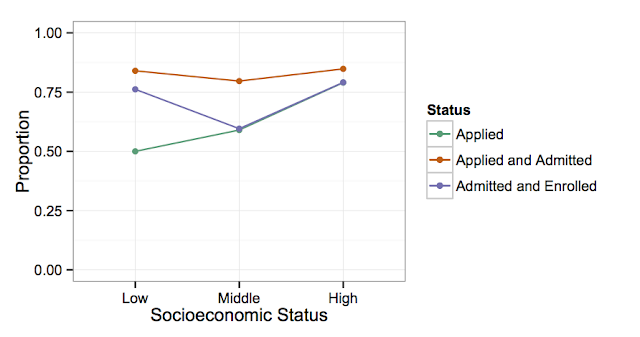
Radford attributes the large gap between High SES valedictorians and Middle and Low SES valedictorians to reduced familiarity with highly selective schools as institutions and their admissions process. That seems to ring true to me, but I was curious how SES affects each step in this process. The graph above doesn't really tell you what proportion of Low SES students who actually applied to highly selective schools were admitted, or at least I don't believe it does. It says 42% of Low SES valedictorians were admitted to a highly selective school, but you have to apply to be admitted, and only 50% of Low SES valedictorians applied in the first place. That means that 42%/50% = 84% of Low SES students who applied were admitted. The same goes for enrollment. You have to be admitted to be enrolled, meaning the 32%/42%=76% of Low SES students who were admitted to a highly selective school also enrolled. Here's a rejiggered plot I made based on the data in the plot above.
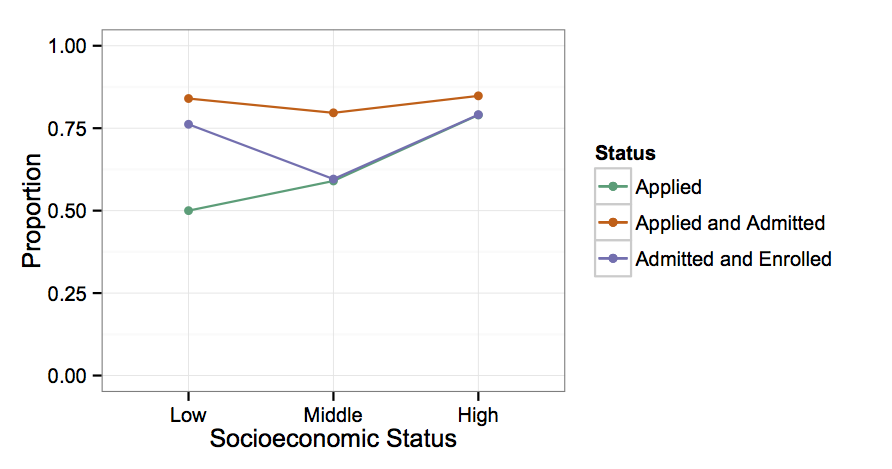
So, it looks like to highly selective colleges' credit, the proportion of high school valedictorians who sent in applications who were then admitted is just about flat across the socioeconomic scale. 85% of High SES valedictorians who applied were admitted, and 84% of Low SES valedictorians who applied were admitted. Things look really different for enrollment though. High and Low SES students have very similar enrollment yield, (79% and 76%, respectively), but Middle SES students have much lower enrollment yield (59.6%).
I can only speculate why Middle SES students have such a lower enrollment yield than Low and High SES students. One possibility is that their family's income is just a little bit too high to qualify for needs-based scholarships. Another might be that the perceived cost-benefit ratio for Middle SES students is higher than for Low SES students.
However, I think this plot lends credence to Radford's hypothesis that reduced information and familiarity leads to reduced Low SES application rates. For Low SES valedictorians, their application rates are totally disproportionate to the probability that they will be accepted to the highly selective schools, and to the probability that they will actually attend those schools if they are accepted.
Update: I meant to include the R code for the data and plot.
Update: I meant to include the R code for the data and plot.
Update 2:
Of course, admission is not even half or a quarter of the battle. I don't know much about the The High School Valedictorian Project mentioned in the study, but I hope they keep tabs on the Low SES students admitted to the highly selective schools. I know the culture shock I experienced going from a good diocesan high school to an Ivy League university was pretty huge, but I don't know if it was disproportionately huge than it would have been going from any old high school to any old college, or what effect it might have on academic performance.
Subscribe to:
Posts (Atom)